...

YETI vs. Stanley vs. Owala vs. Hydro Flask: Which Water Bottle Is Actually Best in 2026?

Four huge water bottle brands, four very different reasons to buy. Here’s how Ythey compare... and which one makes the most sense for you.

If you buy something from the links on this page, we may earn a commission. Our review process.

Yeti vs Stanley vs Owala vs Hydroflask Review 2026

Here's the thing about tumbler reviews: they all sound extremely confident, and they all say different things.

The same Stanley 40 oz has been reported as running out of ice in under 6 hours. It's also been reported as holding ice for 36. Same cup, same size. Nobody's lying, exactly. But somebody is definitely not measuring the same thing.

So we read 38 of these tests, checked the math on every one that showed its work, and found four that are flat out impossible. Not sloppy. Impossible.

Here's what actually holds up. And if you're standing in a store right now with a cart and no patience, the next bit is for you.

The short version

You want to know which one to buy. Here you go. Everything after this is me showing my work.

Best overall, while it lasts Yeti Rambler 35 oz$29.40 Zero leak complaints. Not "a few." Zero, out of 40 reviews written by people who were already annoyed. Yeti is discontinuing it, which is just our luck, so it's currently 30% off.
The safe pick Stanley Quencher 40 ozabout $33 You probably already own one, and it's genuinely good. Just know that leaking is its single biggest complaint, so maybe don't toss it in a tote with your laptop.
Best for your car Owala 40 oz Tumbler$44.99 The only brand that will actually tell you how wide the bottom is (2.92 inches). Everyone else says "fits most cupholders" and lets you find out in the parking lot.
Great cup, maddening straw Hydro Flask 40 oz$39.95 41% of its complaints are about the straw. It suctions shut, it's half silicone, and its shape blocks you from swapping in a normal one. The cup underneath is fine.
Think twice Yeti 40 oz Travel Straw Mug$48.00 The only cup here promising 100% leakproof, and the only Yeti people say leaks. It's also brand new, so honestly nobody knows much yet.

That's the answer. If you want to know why every other tumbler article you've read contradicts this one, keep going. It gets weird.

How long does the ice last? Nobody agrees

Every published hours-to-ice-out result we could find, plotted on one scale. Each dot is one test. Diamonds are the four whose own numbers don't add up. The short version: these tests disagree with each other far more than the cups differ from each other.

Stanley Quencher 40 oz5.7 to 36 h
Owala FreeSip and Tumbler1.0 to 28 h
Hydro Flask 40 oz5.5 to 24 h
Yeti Rambler2.2 to 43 h
0 h15 h30 h45 h
math checks out or can't be checked published numbers are impossible

The Owala row is the strangest thing in the data. Published times for the FreeSip run from 1 hour to 28 hours, and they run backwards to size: the 40 oz was reported empty of ice in an hour while the 24 oz was reported still holding ice at 24 hours. No physical story explains that.

Why they all disagree

Because nobody controls the ice. That's it. That's the whole answer.

One widely read test put a single ice cube in each tumbler. One. Another used 500 grams. Six tests used no ice at all, and five of those never mention it, which hasn't stopped people from citing them as ice tests. Not one of the 38 pre-chilled the cup first. Exactly one ran the test twice and got a different winner the second time, then published both results, which honestly, respect.

So when you read that a cup holds ice for 11 hours, that isn't really a fact about the cup. It's a fact about how much ice somebody put in it.

Then there are the four that couldn't have happened.

One site was refreshingly specific about its method: 4 oz of ice, 16 oz of room temperature water at 74 degrees, cups left sitting at 72. Great, that we can check. So we did the math, and the numbers fight each other. Cooling that much water down to freezing dumps about 46,000 joules of heat. Melting all that ice only soaks up about 38,000. The water wins. Every cube is gone the moment you pour, before the room does anything at all, and you're left with roughly 38 degree water and no ice in it.

That site reports ice lasting 36, 39 and 43 hours. In a magic perfect thermos, that still can't happen. The detail is what gives it away: they supplied every number a skeptical reader would ask for, and the numbers disprove the answer.

Two more come from a company that sells its own competing tumblers, which, sure. Both of their tables show the temperature climbing while there's still plenty of ice floating in the cup. Ice water sits at 32 degrees until the last of the ice is gone. That's not an opinion, it's just how ice works.

The fourth presented two figures as its own testing. Both turned out to be other people's published results, attached to the wrong products.

One source came out of this looking great, for the record. A university design review published real weights and real starting temperatures, and when we worked their experiment from scratch we predicted 88.7 degrees against their published 89. That's how you do it.

So what can you actually say?

That all four are competent vacuum flasks, and that the differences between them in ice retention are smaller than the differences between tests of the same cup. Fill any of these most of the way with ice, keep the lid shut, and there'll be ice in the morning.

Which means the decision isn't about insulation at all. It's about the things that vary enormously and get almost no coverage: whether it fits your car, whether it survives a bag, how heavy it is full, and how many pieces you have to wash. Those are the rest of this guide.

Will it fit your cupholder?

The most asked question in this category, and the one with the least published data behind it. Only one of these brands tells you how wide the base is. Here's the workaround: a standard soda can is 66 mm across, and you own one.

Base width isn't the whole story, and this is the gap worth knowing about: these cups taper, so what usually jams is the body an inch or two up, where the holder's rim sits. Not one of the four brands publishes that number. Treat a pass here as necessary rather than sufficient.

What people actually complain about

We read 231 one and two star reviews and tagged every gripe. These are the share of complaints that mention each thing, and the orange bar is each cup's signature problem. The short version: every cup has one thing people gripe about, and the Yeti 35 oz basically doesn't have one.

CupLeaksStrawInsulationFinishCupholderFakesReviews
Stanley 40 oz27%13%1%10%9%6%67
Owala 40 oz21%17%7%3%0%3%29
Hydro Flask 40 oz14%41%20%9%7%4%56
Yeti 35 oz0%5%13%15%3%0%40
Yeti 40 oz Travel15%15%8%13%0%0%39

One caveat worth printing: marketplace review pages are capped, so these are the reviews the site shows across its star and sort filters, pulled the same way for every cup. Fair for comparing cups to each other. Not failure rates.

The practical stuff

Ice gets all the attention, so we went and answered the questions people actually ask instead. The short version: if you want hot coffee in it, it's the Owala or the Stanley. Both Yetis and the Hydro Flask are ruled out by their own makers, and only the Yeti 40 oz is genuinely leakproof.

CupHot drinksDishwasherStrawLid seal
Stanley 40 ozYes, with the lid turned to full cover. Measured at 202F down to 162F after 4 hours.All parts, top rack. Finish damage is the real risk, and the warranty excludes it.Removable. Official 4-pack, $15.!Splash-resistant only. The ProTour Flip Straw lid fits every 40 oz Quencher and is leakproof.
Owala 40 ozYes, and it's the only one the brand comes out and endorses. No hours published.!Lid and straw yes. The cup is hand-wash, so machine-washing it is off-label.Removable. Replacements are $1.99.!Splash-resistant. No alternative lid is sold for it.
Hydro Flask 40 ozNo. The straw lid is rated against hot drinks, and no other lid fits this cup.Yes, and Hydro Flask names this exact tumbler as dishwasher safe.Removable, trims to fit. 3-pack, $4.95.!Leak-resistant, not leakproof. No alternative lid exists.
Yeti 35 oz!Not with the straw lid. A $10 MagSlider swap allows it, up to 185F.Yes. Body on any rack, lid up top, gaskets in the silverware tray.Removable. L/XL straw pack, $10.No leak claim at all, and the MagSlider alternative isn't leakproof either.
Yeti 40 oz TravelNo. Cold or room temperature drinks only, in Yeti's own words.Yes, same routine. Pull the gasket out or it stays dirty.!Built into the lid. The replacement part is the $13 lid, not a straw.The only one of the five its maker calls 100% leakproof.

Why three of them say no to hot drinks: a straw lid is an open hole, and a sealed one traps steam pressure. Yeti bans hot liquid in both straw mugs outright. Hydro Flask bans it in the lid rather than the cup, which amounts to the same thing since no other lid fits. Stanley never addresses it, but its lid twists to a full-cover position, which is why it gets away with staying quiet.

The two upgrades worth knowing about: Stanley's ProTour Flip Straw lid fits every 40 oz Quencher and is properly leakproof, which turns the most-complained-about cup here into a bag-safe one. And a $10 Yeti MagSlider lid makes the 35 oz hot-capable up to 185F, though it still won't stop a spill.

One number nobody publishes: how long any of these keeps a drink hot. Only the Stanley has been measured, at 202F down to 162F over 4 hours. Every other hot figure we found was for a different size or a different lid, so we've left those blank rather than borrow them.

Mold, and a number we threw out

Our first pass through 549 owner forum posts put Owala's mold complaints at 33%, the highest of the four, which fit neatly with a documented complaint about a gasket ring being hard to clean. Then we removed the threads our own searches had seeded with the word mold, and it fell to 2%. The 33% was measuring our search terms, not the product. It isn't in this guide, and we're telling you it existed because a number that convenient is exactly the kind this guide is about.

What survived is more useful anyway. Of the substantive comments about mold, the overwhelming majority attributed it to washing habit, and not one blamed a particular brand's design. The locations are identical across all four brands: gaskets, lid channels and straws. Mold lives wherever there are parts, not wherever there's a logo.

So the honest comparison isn't which brand molds. It's how many pieces the lid comes apart into, and whether you can see every surface once it's apart. Fewer parts beats a better logo, and a two-piece lid you can inspect will stay cleaner than a cleverer one that hides a channel you can't reach.

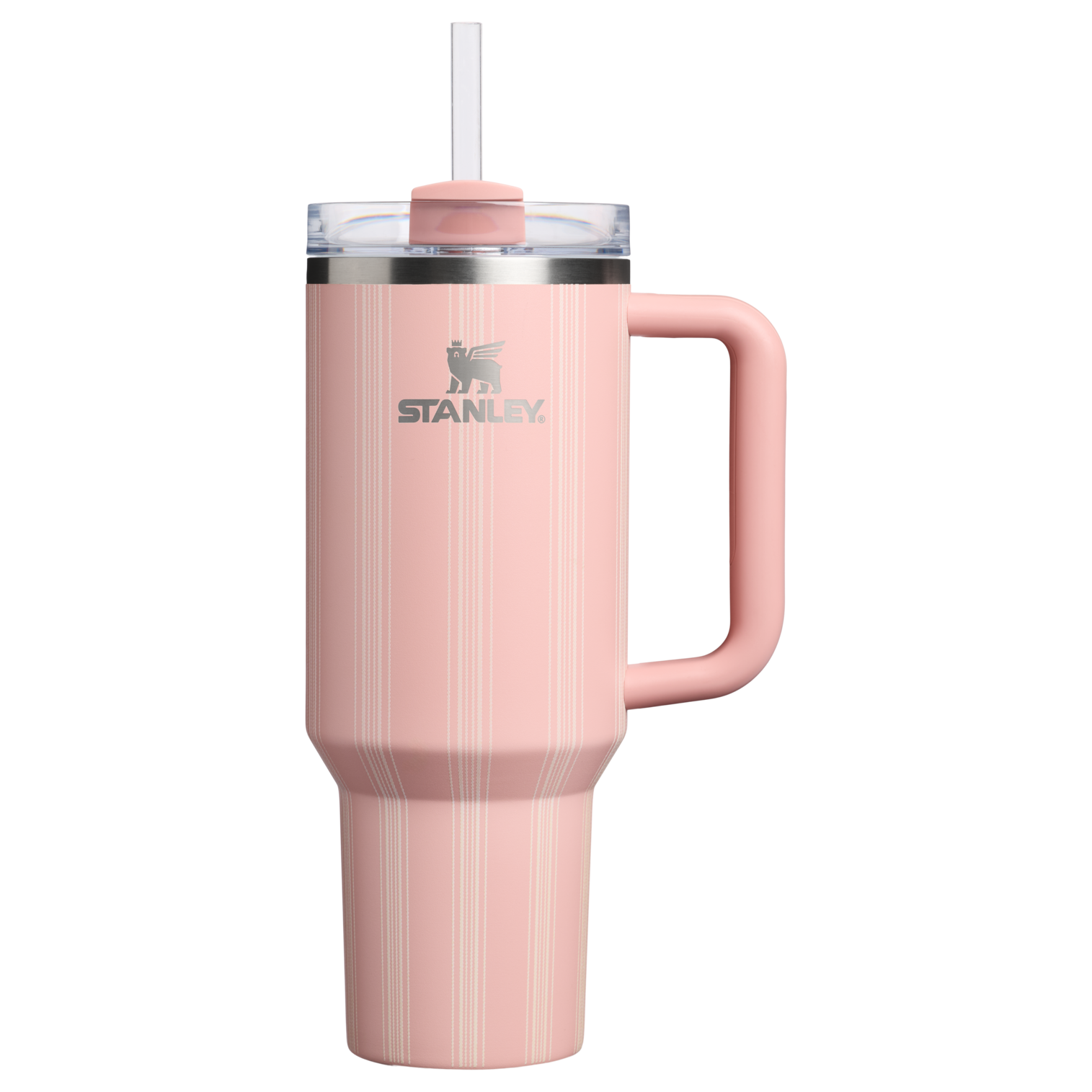
Stanley Quencher H2.0 FlowState
1
For the one everybody already owns
$33.0040 oz3-piece lid
The cup that created the category, and the one with the most published testing behind it, which is exactly why the contradictions are easiest to see here. Its 24-hour readings range from 37F to 55F depending on who measured. What owners actually gripe about is narrower and more consistent than any lab result: leaking is the top theme in 27% of its critical reviews, and it's the only cup in this guide where cupholder fit shows up as a spontaneous complaint.
Heads Up
Stanley's own product pages give three different weights for this same cup across colorways. It's also the only one where buyers routinely say they think they got a fake, at 6% of critical reviews. Buying direct removes that question entirely.
Owala 40 oz Tumbler
2
For the brand that publishes the most and claims the least
$44.9940 oz2.92 in base
Owala is the only one of the four that publishes a base diameter, and the only one whose marketing doesn't reach past what it can support: its own page says splash-resistant, not leakproof. That honesty is worth something in a category this loose with numbers. The FreeSip line is also responsible for the widest contradiction we found anywhere, with published ice times running from 1 hour to 28 hours.
Our Take
The 2-in-1 lid sips or swigs, which is genuinely useful, but every extra moving part is another place water sits. Owala's own FAQ tells you to pull the spout gasket and soak it, which is a quiet admission that there are places you can't otherwise reach.
Hydro Flask 40 oz Travel Tumbler
3
For the one whose problem isn't what you'd guess
$39.9540 ozPress-in lid
Everyone assumes a Hydro Flask complaint would be about insulation. It isn't. The straw is the dominant theme by a wide margin, appearing in 41% of critical reviews, the single highest concentration for any cup in this guide. Owners describe it as half silicone and half plastic, suctioning shut in use, and shaped so you can't swap in a normal stainless straw. Insulation is second at 20%, which does show up on two separate review corpora.
Heads Up
Hydro Flask's own page calls this lid splash-resistant. At least one major retailer's listing for the same cup says it's truly spill proof. Those aren't the same claim, and the brand's is the conservative one.
Yeti Rambler 35 oz Straw Mug
4
For the one with the cleanest record and a countdown on it
$29.4035 ozBeing retired
This is the strongest performer in the owner data by a clear margin: zero leak complaints across 40 critical reviews, against 27% for Stanley and 21% for Owala. Not few, zero. The welded handle appears to remove the failure that dominates the others outright. Yeti also quietly changed this handle in February 2026, so a cup bought before then is a different product from one bought after.
Why We Picked It
Yeti tagged this line Hitting the Road in August 2026 and cut it from $42.00 to $29.40. Every published test we found used this cup, and it's the one being discontinued. If it suits you, the discount is real and the stock is finite.
Yeti 40 oz Travel Straw Mug
5
For the replacement nobody has tested yet
$48.0040 ozQuick-Flip lid
The cup Yeti is moving to, and the only one here that matches the others at 40 oz. It's also the only product in this guide claiming to be 100% leakproof, and the only Yeti with a leak pattern in its reviews, at 15%. Owners describe it leaking upside down and on its side. One plausible explanation sits in the reviews themselves: the gasket is hard to reseat correctly after washing, and there's no instruction covering it.
Heads Up
It's too new to judge properly. The review corpus is a fraction of the others, most of it is weeks old, and a large share carries a received-incentive tag. Time-dependent failures like gasket wear and coating chips simply haven't had time to appear. Also worth knowing: at $48.00 it isn't intended for hot drinks.
The bottom line

We're not giving this a Best Overall, because the whole point of the last 1,500 words is that these can't be honestly ranked on the thing everyone ranks them on. So, by decision instead.

If it has to fit your car, measure the holder first and treat every brand's fits most cupholders as marketing. Only Owala publishes a base width, and none of them publish the width that actually jams.

If it has to survive a tote bag, the owner data points one way. The Yeti Rambler 35 oz drew no leak complaints at all, while Stanley's leading complaint is leaking. Note that the 35 oz is being retired, and that the cup replacing it is the one making the leakproof claim and drawing leak complaints.

If you want the least washing up, count the lid pieces in the photos before you buy and pick the smallest number you can live with.

If price decides it, the Yeti 35 oz at $29.40 is a run-out discount on the cup with the cleanest record in this guide, and the Stanley is routinely available for around $30. Both are genuinely good vacuum flasks, which is true of all five.

Frequently Asked Questions
Is the Stanley lead thing real? +
Partly, and the accurate version matters. There's lead in a Quencher, in a pellet of solder that seals the vacuum at the base of the cup. That pellet sits under a stainless steel cap and never touches your drink. The viral videos used at-home test kits that the Consumer Product Safety Commission says aren't reliable on metals, and an independent lead researcher who checked found nothing detectable on the exterior or the lid. Class actions were filed and a federal judge dismissed them twice, most recently in April 2026. There has never been a recall of the Quencher over lead. Stanley did have a real recall, in December 2024, covering about 2.6 million Switchback and Trigger Action travel mugs whose lids could detach and cause burns. Those are a different product.
Will any of these really keep ice for 24 hours? +
It depends almost entirely on how much ice you put in, which is the thing no test controls. Published results for the same Stanley 40 oz run from under 6 hours to 36 hours, and the tests at the short end used a single ice cube while others used half a kilo. Ice retention isn't really a property of the cup, it's a property of the ice charge, the starting water temperature and the room. All four of these are competent vacuum flasks. If you fill one most of the way with ice and keep the lid shut, you'll have ice the next morning in any of them.
Why is the outside of my tumbler sweating? +
That's the one symptom worth acting on. A working vacuum flask should not form condensation on its outer wall, because the outer wall shouldn't be getting cold. If yours is sweating, the vacuum between the walls has most likely failed, usually after a hard drop, and the cup will no longer hold temperature the way it did. It's also the clearest thing to point at in a warranty claim, because it's visible rather than a matter of opinion about how cold is cold.
Which one is easiest to keep clean? +
Count the pieces. Across hundreds of owner comments the pattern is consistent and it isn't about brands: mold appears in gaskets, straws and lid channels, and it appears in every brand's gaskets, straws and lid channels. Of the substantive comments we read on the subject, the overwhelming majority attributed mold to washing habit and not one blamed a particular brand's design. The practical rule is that fewer parts beats a better logo. A lid that comes apart into two pieces you can see is easier to keep clean than a cleverer one that comes apart into five.
Is the Stanley I bought on a marketplace a fake? +
You probably can't tell, and that uncertainty is itself the finding. Suspected counterfeits appear in 6% of the Stanley critical reviews we read, the highest of any cup here, and the complaints are consistent: a finish that fails immediately, a lid that doesn't seal, a cup that doesn't hold temperature. What we could not find was any verified seizure or lab testing confirming a flood of physical fakes, so we're reporting what buyers believe rather than something proven. What is documented is a wave of fraudulent websites selling Stanley cups cheap and shipping nothing. Buying from the brand or a retailer you recognize removes the question.
Method and sources

We read 38 published ice-retention tests, 231 critical owner reviews across five products, and 549 owner forum posts, and we checked the math on every test that gave us enough numbers to check. We didn't test these cups ourselves, and nothing in this guide is presented as a first-hand measurement. Where a figure came from someone else, the sentence says so. The sites whose numbers are impossible are described but not named or linked, because sending traffic to them isn't the point.