 Skip to content
Yes, and it’s the better half of the year for it. Trimmers get promoted hard in spring when everyone is thinking about the lawn, and the prices that follow in late summer come from a different place: retailers clearing outdoor power stock before the fall lineup arrives. Columbus Day Weekend is where that starts. You also still have a few weeks of growing season left to actually use it, which is the part people forget when they wait for Black Friday and end up storing a trimmer until April.
The number that decides whether a trimmer works for your yard isn’t the voltage on the battery. It’s the line diameter the head is rated to take, and it’s the one spec nobody reads. Below you’ll find live deals by type, a chart matching line thickness to what you’re actually cutting, and the shaft question that matters more than any brand argument.

Early Columbus Day String Trimmer Deals
One brand is discounting real trimmer kits on its own site in this window, and the cuts sit on the versions with the battery included. These are the live markdowns, checked against the product page.

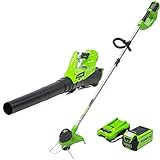
Greenworks 40V 12 in. String Trimmer and 390 CFM Leaf Blower Combo Kit
- 40V 2.0Ah battery included
- Up to 30 min runtime
- Yards to 1/3 acre
The trimmer and a 390 CFM blower in one box with the 40V 2.0Ah battery and charger, which the listing rates at up to 30 minutes of runtime and sizes for yards up to a third of an acre. The battery is the expensive part of any cordless system, and here it comes with two tools instead of one.
Buy this if you own neither tool, because $119.99 is about what a bare 40V trimmer costs on its own. The 2.0Ah battery is the small one, so a second battery is the upgrade to plan for if the yard is at the top of that range.
$119.99$199.9940% off

Greenworks 24V 15 in. Brushless String Trimmer with 6.0Ah Battery
- 15 in. cutting path
- .080 in. dual line
- Up to 60 min runtime
The widest cut in the 24V line, with .080 inch dual line on a Quickload bump feed head, a two-speed motor at 5,000 and 6,000 RPM and a 6.0Ah battery the listing rates at up to 60 minutes. It weighs 6.06 lb without the battery and charges over USB-C.
Line diameter is the spec this page keeps coming back to, and .080 is the thick end for a 24V tool, which is why this one handles the weeds the 12 inch models push over. The charger is the same 65W USB-C type a laptop uses, so a spare is cheap.
$139.99$179.9922% off

Greenworks 24V 13 in. Brushless String Trimmer and Edger with 4.0Ah Battery
- 13 in. cutting path
- Converts to edger
- Up to 50 min runtime
The two-in-one that flips from trimming to edging, with a 4.0Ah battery the listing rates at up to 50 minutes, a 5.51 lb tool weight without the battery, and a bonus trimmer head with 10 blades in the box.
If the yard is a lawn and a driveway, the edging mode is the feature that gets used every week, and the blade head lets you run it without line along a fence. Charging takes 110 minutes, longer than the 15 inch model, so it suits a yard you finish on one battery.
$109.99$139.9921% off
Prices come from Greenworks at the time this page was last refreshed. The brand runs some of its cuts as 48 hour flash sales; the three above aren’t flagged that way, but check the current number on the product page before you buy.
String Trimmer Deals On Sale
Every one of these is discounted, cheapest first.



Line Diameter Is the Spec That Matters
Match the line to what you’re cutting, then check the trimmer is rated to take it. Going thicker than the head allows overworks the motor.
| What You’re Cutting | Line Diameter | Shape to Look For |
|---|---|---|
| Grass around the lawn, edges, fence lines | .065 to .080 inch | Round. It’s durable and survives clipping concrete, and it tears rather than slices, which barely matters on soft grass. |
| Thick weeds and fibrous stems on a bigger lot | .080 to .110 inch | Twisted or square. Both actually cut instead of tearing, and twisted line runs noticeably quieter. |
| Dense overgrowth, woody stems, real brush | .110 inch and up | Twisted or serrated, and at this point look hard at whether you want a brush cutter blade instead. |
| Anything, if the trimmer is a small cordless | Whatever the manual says, and not a size up | Oversized line makes the motor work harder for no gain. Undersized line snaps every few minutes on a powerful head. |
The trap is buying a bigger spool because it sounds tougher. Line thickness is capped by the head your trimmer came with, and the cheapest way to make a good trimmer feel bad is to feed it the wrong string.
What Actually Counts as a Good String Trimmer Deal
Once the line question is settled, these are the things that decide whether you’re still happy with it next summer:
- Straight shaft or curved shaft. Curved is lighter, cheaper and easier to swing around a lawn. Straight gives you reach under bushes and fences, suits taller people, and it’s the only kind that takes brush cutter attachments. This decides more about how the tool feels than the brand does.
- How the line feeds. Bump feed means tapping the head on the ground to advance line, automatic feeds itself, and fixed line means clipping in a new piece by hand. Automatic sounds best and wastes the most string. Bump feed is what most people end up preferring.
- Whether the battery is in the box. The same trap as every cordless tool. A bare tool at a great price is only a great price if you already own the pack, and a spare battery often costs more than half the trimmer.
- The platform you already own. If there’s a Ryobi, EGO, Greenworks or DeWalt battery in your garage, buying into that same system beats any discount on a different brand. Batteries don’t cross over between them.
- Cutting width, within reason. A wider swath clears faster and pulls harder on the motor and your arms. Twelve to fourteen inches suits most yards, and sixteen and up belongs on a bigger lot with a bigger battery behind it.
Where to Shop String Trimmers
Brand stores are worth the detour here, because that’s where the battery and trimmer bundles live and where last season’s models get cleared. All four of these are stocked and discounting.
How to Pick the Right String Trimmer
You already own cordless tools. Buy the bare tool on your existing battery platform and skip everything else on this page. Nothing here beats a trimmer you can already power.
Your yard is a lawn, a driveway and a fence line. A light curved-shaft cordless in the 12 inch range is plenty, and the two-in-one models that flip to an edger save you buying a second tool.
You’re fighting weeds rather than trimming grass. Go straight shaft, check the head takes .095 line or thicker, and expect to buy line by the spool rather than the cartridge.
You’re clearing brush or an overgrown lot. This is where gas still wins, and where a brush cutter blade beats any string. A straight shaft is required for those attachments, so don’t buy curved and find out later.
You’re tall, or your back complains. Straight shaft, every time. The curved ones put your hands closer together and your shoulders further forward, and twenty minutes in you’ll feel exactly where that went.
String Trimmer Sale FAQ
The Bottom Line
Buy the shaft and the line diameter, not the voltage. A straight shaft with a head rated for .095 line handles weeds and takes attachments later, and a light curved-shaft cordless is all a normal lawn ever needs. If you already own a battery, buy the bare tool on that platform and ignore every other price here. Line is the cheapest thing on this page and the fastest way to make a trimmer feel better or worse, so get the diameter right before you blame the machine. Columbus Day weekend is when the clearance starts, and buying now still leaves you most of a season to use it.
