 Skip to content
It’s the tail end of the quiet season, which is the best time for clearance and the worst time for choice. Demand for these arrives with the first cold week, so late summer is when discontinued models and overstock get moved and when freight is cheapest and fastest. Black Friday is still the deepest and broadest window of the year. Buying now gets you a better shipping experience and last year’s models cut properly; waiting until late November gets you a bigger discount on current stock.
Before you compare a single price, one fact reshapes the whole decision. Every plug-in electric fireplace sold in America puts out essentially the same heat, because they’re all capped by the same household outlet. A three hundred dollar unit and a three thousand dollar unit warm a room identically. What the extra money buys is how convincing the fire looks, and that’s a real thing to pay for as long as you know that’s what you’re paying for.
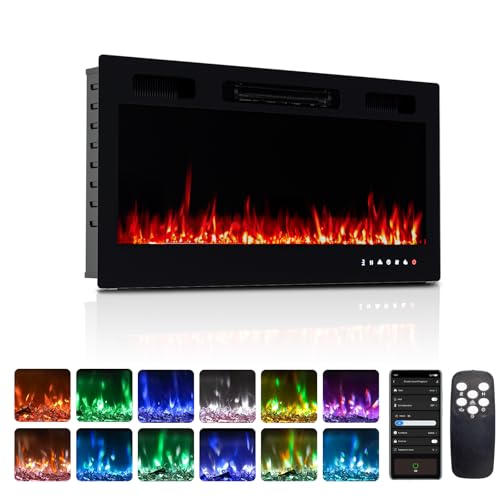
Electric Fireplace Deals On Sale Right Now
Every one of these is discounted right now, cheapest first.


Every Plug-In Model Makes the Same Heat
A standard American outlet sets a hard ceiling, and no amount of money moves it. This is the most useful thing to know before you shop.
| What | The Number | Why It Matters |
|---|---|---|
| Standard plug-in output | 1,500 watts, about 5,100 BTU | The largest load a normal 120 volt household outlet will take. Nearly every model on the market lands here, whatever it costs. |
| What that actually heats | Roughly 150 to 200 square feet as real heat | Marketing claims of 400 to 1,000 square feet assume the house is already heated and you just want to take the chill off one room. |
| Cost to run with the heat on | Around 28 cents an hour | Based on the current US average electricity price of about 18.4 cents per kilowatt hour. Call it forty dollars a month at five hours a day. |
| Cost to run flames only | Well under a cent an hour | The flame effect draws a tiny fraction of what the heater does. Year-round ambience is close to free, and it’s the heating element that costs money. |
| Hardwired 240 volt models | 2,500 watts and up, around 8,500 BTU | The only way to get meaningfully more heat. Needs a dedicated circuit like an electric dryer and an electrician to install it. |
So the price ladder is about the fire, not the furnace. Cheap units spin a rod with reflective tabs to bounce light onto a screen, which looks repetitive and washes out in daylight. Mid-range units project onto a stencil and hold up in a bright room. The most expensive ones vibrate water into a fine mist lit from below, producing flame and smoke with real depth, at the cost of adding humidity to the room.
What Actually Counts as a Good Electric Fireplace Deal
With heat output off the table as a differentiator, here’s what to actually compare:
- How the flame is produced. This is the whole price ladder. Look for projection rather than a spinning rod if you’ll see it in daylight, and treat water-vapour models as a luxury purchase rather than a heating one.
- Which way the heat vents. Many units blow heat forward or downward rather than straight up, which is exactly what you want if a television is going above it. Check this before you buy, because it’s the difference between a workable wall and a warm TV.
- Whether it needs hardwiring. Recessed and built-in models frequently do. That’s an electrician, not an afternoon, and it belongs in the budget from the start.
- Depth, if you’re recessing it. Slim in-wall units still need the right stud depth, and the measurement that catches people out on a masonry insert is depth at the back of a tapered firebox rather than the front.
- Whether it runs flames without heat. Almost all do, and it’s the mode you’ll use most. A unit that forces the heater on to show a fire is a worse buy at any price.
Fireplace TV Stands and Consoles On Sale
The most popular format by a distance, because it solves the fireplace and the television in one piece of furniture.


Wall Mounted and Recessed Fireplaces On Sale
The linear look, either hung on the wall or set into it. Recessed installs are tidier and usually need an electrician.


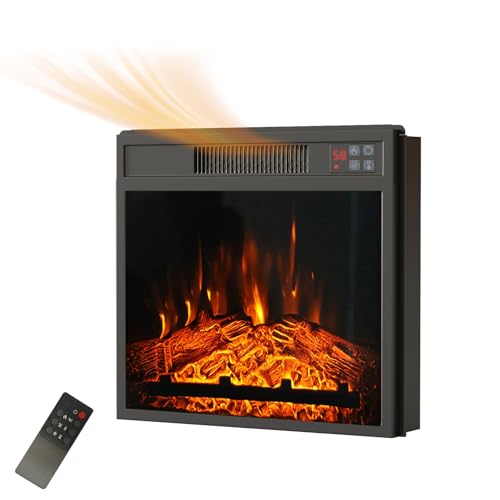
Freestanding Stoves and Inserts On Sale
Stoves plug in anywhere and move with you. Inserts drop into an existing masonry firebox with no venting and no chimney work.
Where to Shop Electric Fireplaces
This is a category where the specialists carry things the general stores never will, particularly at the realistic-flame end. All four below are stocked right now.
How to Pick the Right Electric Fireplace
You want it mainly for the look. Spend the money on flame technology and ignore the heat specification entirely, because it’s the same on every plug-in model. Running the flames alone costs almost nothing.
You need it to actually warm a room. Expect one room of about 150 to 200 square feet, and treat it as supplemental. If you need more than that, you need a 240 volt hardwired unit and an electrician.
A television is going above it. Leave at least 8 to 12 inches of clearance and choose a model that vents forward or downward. Most TVs are rated to around 90 to 100 degrees Fahrenheit ambient, and that’s the number that matters.
You have an unused masonry fireplace. An insert is the easiest win in this whole category. Clean the firebox, slide it in, plug it in. Measure the depth at the back rather than the front, because tapered fireboxes are what ruin these orders.
You rent, or you might move. A freestanding stove or a console. Both plug into a normal outlet, neither touches the wall, and both come with you.
Electric Fireplace Sale FAQ
The Bottom Line
Shop the fire, not the furnace. Every plug-in electric fireplace in America is capped at the same 1,500 watts by the same household outlet, so a cheap one and an expensive one will warm your room identically, and the price difference is entirely about how convincing the flames look and how well the thing is built. Decide honestly whether you’re buying heat or atmosphere. If it’s atmosphere, spend on flame technology and enjoy the fact that running it costs almost nothing. If it’s heat for a real room, you want 240 volts and an electrician. Labor Day weekend is clearance season with better shipping, and Black Friday is the deeper discount if you can wait.
